Aug 21, 2026 Choose Guiding
Building Plaques Guide | Names, Entrances & Dedications
Explore building plaques for names, entrances, dedication dates and architectural information, with guidance on metals, engraving, sizing and installation.
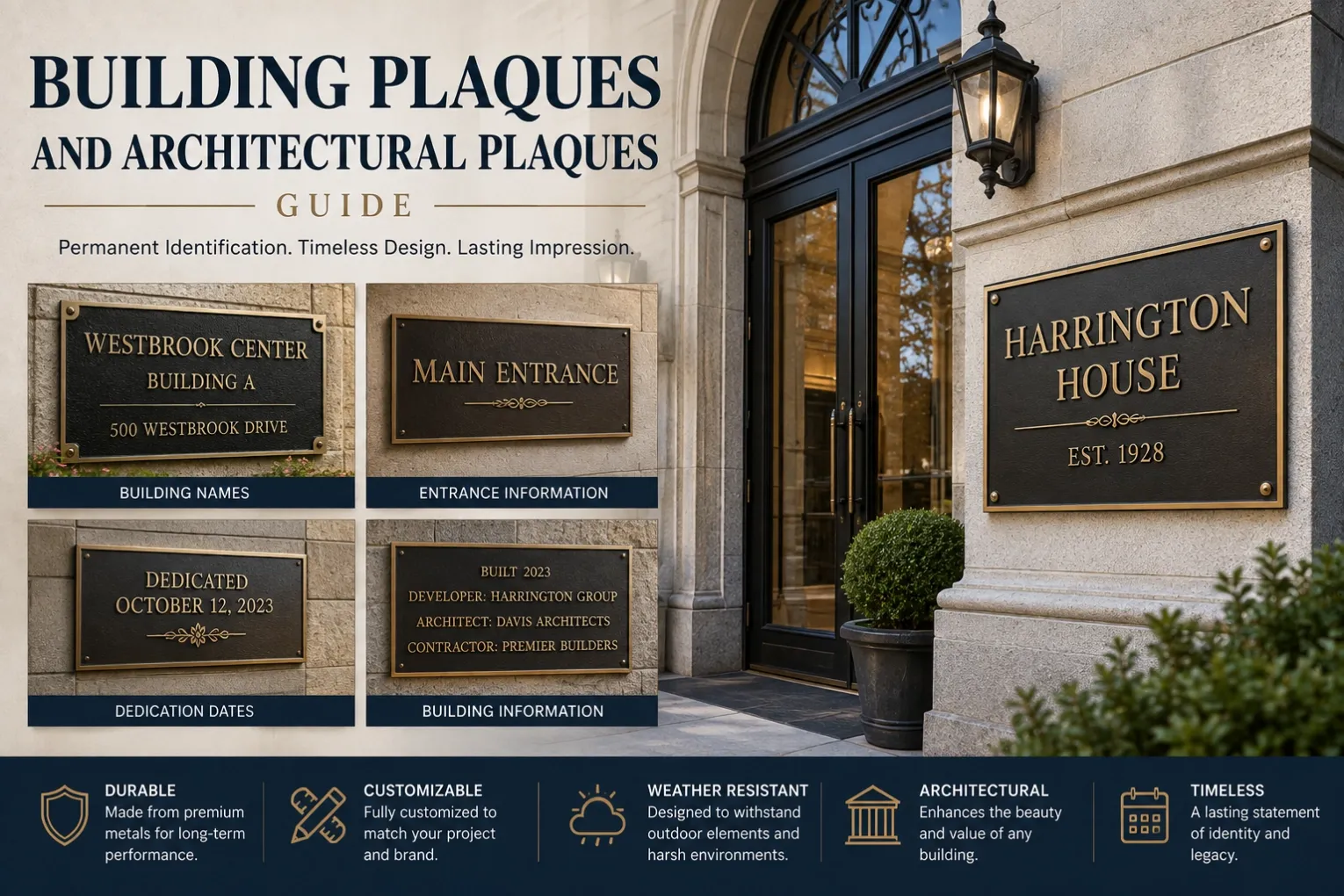
Building Plaques Guide | Names, Entrances & Dedications
Meta Description:
Explore building plaques for names, entrances, dedication dates and architectural information, with guidance on metals, engraving, sizing and installation.
An engraved metal plate at a building entrance can do much more than display a name. It can identify a property, record when it was completed, recognize the people behind a project, communicate historical information, or become a permanent architectural feature.
That is why Building Plaques, Architectural Plaques, Building Name Plaques, and Dedication Plaques should be considered part of the building design rather than simply added after construction.
For architects, developers, contractors, property managers, hotels, schools, churches and commercial property owners, the important question is not simply, “Where can I get engraving plaques near me?” A better question is:
What type of plaque will remain readable, appropriate and visually integrated with the building for years?
This guide explores the major applications of architectural building plaques and explains how material, engraving method, size, finish, information hierarchy and installation influence the final result.
1. Building Name Plaques: Giving a Building Its Identity
A building name is often one of the first pieces of information visitors see.
Apartment buildings, office developments, hotels, schools, churches, museums, villas and mixed-use developments may all use permanent engraved metal plaques to establish their identity at an entrance.
A typical building name plaque may contain:
- Building name
- Street number
- Logo or emblem
- Establishment year
- Development name
- Property or institution name
Although the information is simple, the design decisions are not.
Why Building Name Plaques Need Visual Hierarchy
The building name should normally receive the strongest visual emphasis. Secondary information such as an establishment date or street address can be smaller.
This becomes particularly important when creating metal engraved name plates for large entrances.
A plaque may look perfectly readable on a computer screen but become difficult to read once installed several meters away.
Designers should therefore consider:
Viewing distance → character size → contrast → plaque dimensions → installation height
rather than choosing plaque dimensions first.
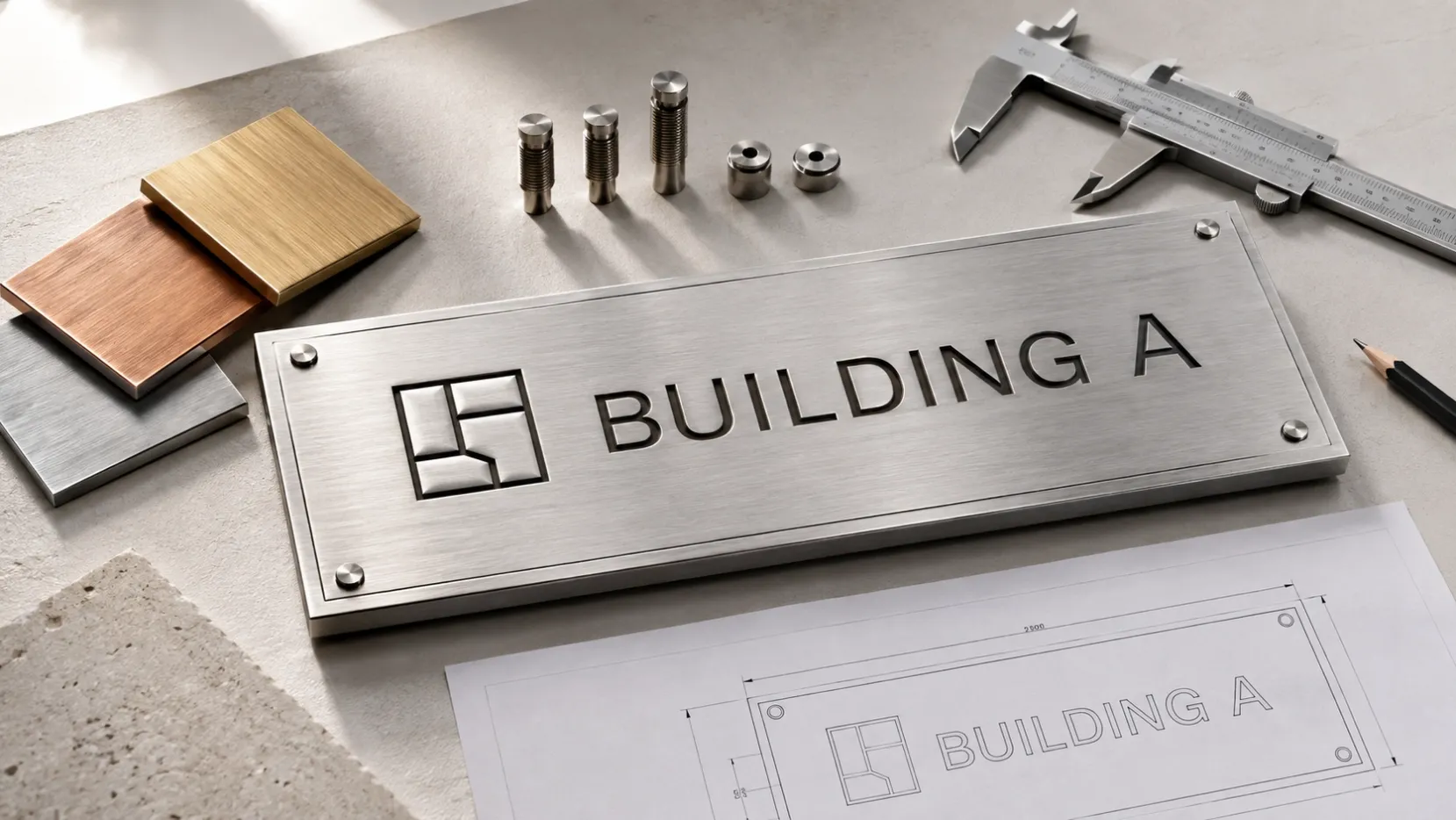
For modern architecture, brushed stainless steel metal engraved plates can create a clean appearance. For traditional buildings, hotels or heritage-style developments, bronze or brass may integrate more naturally with stone, brick and timber.
2. Architectural Plaques for Main Entrances
Entrance plaques have a different role from ordinary signs.
A temporary sign primarily communicates information. An architectural plaque should communicate information while visually belonging to the building.
This is why material, thickness, edge treatment, surface texture, lettering and mounting details matter.
- Building name
- Property number
- Company logo
- Institution name
- Opening date
- Developer information
- Architect information
- Project identity
An office building may need a minimalist stainless steel plaque. A winery might prefer aged brass or bronze. A boutique hotel may require etched metal plaques that reproduce a detailed logo while maintaining a refined appearance.
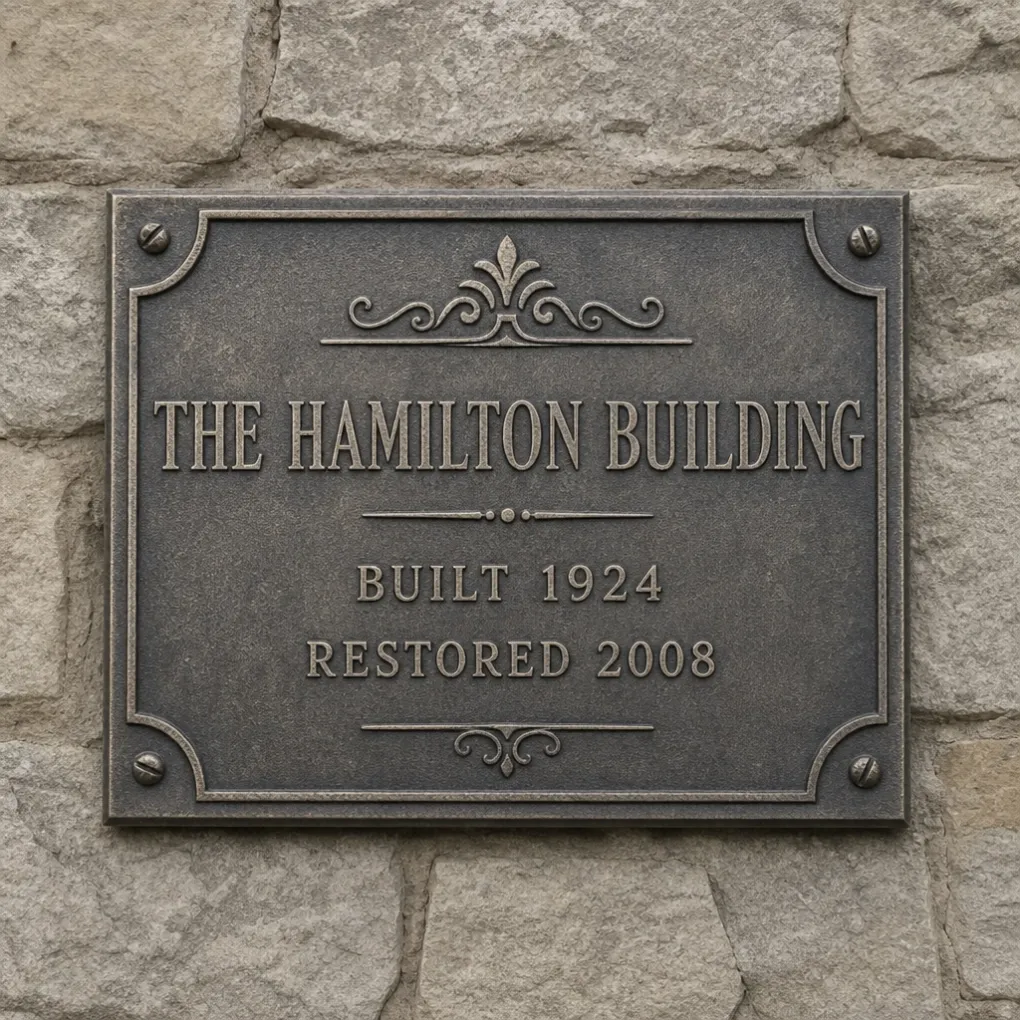
A historic property may benefit from a cast bronze plaque with raised lettering.
The correct solution therefore depends on the architecture rather than on one universally “best” material.
3. Dedication Plaques: Recording Who, Why and When
A Dedication Plaque answers a different set of questions:
When was this building completed? Who made the project possible? Who designed or developed it? Why was it built or dedicated?
These plaques are frequently installed in universities, libraries, hospitals, churches, community centers, government buildings, cultural facilities and corporate headquarters.
A typical dedication plaque might read:
THE HARRISON COMMUNITY CENTER
Dedicated September 2026
Made possible through the support of The Harrison Foundation
Architect: ABC Design Studio
Builder: XYZ Construction
In this application, plaques engraved with names and dates become part of the permanent record of the project.
What Should a Dedication Plaque Include?
A useful hierarchy is:
Level 1 — Project Identity
Building or project name.
Level 2 — Important Event
Completed, opened, founded, restored or dedicated date.
Level 3 — Recognition
Founder, donor, organization or project sponsor.
Level 4 — Project Information
Architect, developer, contractor or project team.
Trying to give every line equal visual weight usually makes the plaque harder to read. Typography should establish a clear order of importance.
4. Building Information Plaques
Some architectural plaques need to communicate more than a building name.
A building information plaque can explain:
- Construction year
- Original purpose
- Architect
- Architectural style
- Renovation history
- Developer
- Builder
- Ownership
- Historical significance
- Project background
This is common for historic properties, campuses, museums, cultural institutions and significant architectural projects.
In these situations, the plaque becomes an interpretive surface.
Engraved, Etched or Cast?
The amount of information and required visual effect influence the manufacturing method.
Deep engraving plaque processes work particularly well for prominent names, dates and relatively simple layouts.
By comparison, etched metal plaques can be useful when the design contains smaller text, detailed line work or complex graphics.
Cast metal plaques are particularly suitable when the design requires raised lettering, raised borders, decorative relief, dimensional logos or a traditional architectural appearance.
There is therefore an important difference between choosing a material and choosing a process.
Material: bronze, brass, aluminum, stainless steel or copper.
Process: engraving, etching, casting, CNC machining, laser marking or relief.
The two decisions should be made together.
5. Choosing the Right Metal for Architectural Plaques
Material affects much more than price. It influences appearance, weight, corrosion behavior, manufacturing possibilities and how the plaque changes over time.
Bronze
Bronze is particularly suitable for dedication plaques, historical buildings, institutional buildings, traditional architecture and cast plaques.
Its warm appearance works naturally with stone, masonry and traditional architecture.
Brass
Brass offers a brighter golden appearance. It is frequently selected for hotels, luxury interiors, offices and decorative entrances.
Stainless Steel
Stainless steel works particularly well with contemporary architecture.
Brushed or polished custom engraved metal plates can be used for corporate buildings, apartments, modern villas, offices, hotels and institutional facilities.
Aluminum
Aluminum offers lower weight and considerable manufacturing flexibility. It can be useful for larger plaques where weight and budget are important considerations.
6. Small Engraved Plaques vs. Large Building Plaques
Not every architectural identification project requires a large sign.
Small engraved plaques are frequently useful for:
- Individual rooms
- Door identification
- Architect information
- Equipment identification
- Small donor recognition
- Building components
- Apartment numbers
- Office names
An engraved plaque small enough for close viewing should not simply be designed as a scaled-down version of a large building plaque.
Fine borders, complicated logos and long text can become visually crowded as dimensions decrease.
For engravable plaques in smaller sizes, simplifying the layout usually produces better readability.
As the plaque becomes smaller:
Reduce information → simplify typography → increase contrast → remove unnecessary decoration.
7. Readability Matters More Than Plaque Size
Buyers frequently begin an inquiry by specifying dimensions:
“Can you quote a 400 × 300 mm plaque?”
But dimensions alone do not tell the manufacturer whether the plaque will work.
A better specification includes:
- Viewing distance
- Installation height
- Amount of text
- Letter height
- Building background
- Lighting
- Expected viewing angle
For permanent room and space identification in the United States, applicable accessibility requirements may also need to be considered.
The ADA Standards for Accessible Design include requirements for certain permanent signs involving raised characters, Braille, character dimensions, mounting positions, non-glare finishes and visual contrast.
The specific sign type and installation should therefore be evaluated during the design process.
8. Contrast and Finish for Better Visibility
Beautiful metal does not automatically produce readable signage.
Imagine polished brass letters engraved into polished brass. The material may look premium, but poor contrast can make the information difficult to read.
Better solutions may include:
- Black-filled recessed letters on brushed brass
- Raised bronze letters against a dark background
- Dark etched text on brushed stainless steel
- Light metal lettering against a darkened surface
Contrast should therefore be considered together with material and finish when designing metal plaques engraved for architectural projects.
9. Outdoor Durability: Design for the Environment
Many building plaques remain outdoors year-round.
That means the manufacturer should know the installation environment before production.
Consider:
- Rain
- Direct sunlight
- Humidity
- Freeze-thaw cycles
- Coastal salt exposure
- Air pollution
- Cleaning chemicals
- Water drainage
A plaque installed outside a beachfront hotel faces very different conditions from one mounted inside an office lobby.
When ordering metal engraved plates, specify whether the project is:
Indoor / Sheltered Outdoor / Fully Exposed Outdoor / Coastal
This information can influence material and finish recommendations.
10. How Should Building Plaques Be Mounted?
Mounting should ideally be decided before manufacturing.
Screw Mount
Visible screws pass through prepared holes. This provides straightforward installation and allows the plaque to be removed when necessary.
Concealed Stud Mount
Studs are fixed to the back of the plaque and installed into drilled holes, creating a cleaner front surface.
Standoff Mount
The plaque sits away from the wall, producing shadow and visual depth. This works particularly well with contemporary architecture.
Adhesive Mount
This can be suitable for certain smaller and lighter plaques where the substrate and installation environment allow it.
Custom Mounting
Stone walls, irregular masonry, curved surfaces and large plaques may require project-specific mounting solutions.
The mounting system should consider the plaque's weight, substrate and environment—not only appearance.
11. What Information Should You Send for a Quote?
Searching for engraved metal plates near me or plaques engraved near me may help identify suppliers, but supplier location alone does not determine whether a manufacturer can produce the required architectural result.
For custom manufacturing, prepare the following information:
- Plaque size — width × height
- Thickness
- Material preference
- Quantity
- Indoor or outdoor application
- Installation location
- Artwork or logo
- Required text
- Preferred finish
- Mounting method
- Project deadline
- Installation environment
If you are requesting custom engraved metal plates, supplying a vector logo such as AI, EPS, SVG or editable PDF can reduce artwork preparation time.
For complicated projects, include a photograph of the wall or entrance where the plaque will be installed.
That single photograph can help the manufacturer understand scale, architectural style, wall material and possible mounting requirements.
12. What About “Engraving Plaques Near Me”?
Searches such as engraving plaques near me, engraved metal plates near me, and plaques engraved near me often indicate strong buying intent.
However, architectural plaque buyers should evaluate suppliers beyond geographic proximity.
Important questions include:
Can they work from architectural drawings?
Can they manufacture the required metal and thickness?
Can they reproduce the logo accurately?
Can they recommend appropriate outdoor finishes?
Can they provide mounting solutions?
Can they maintain consistency across multiple plaques?
For one simple engraved metal plate, a local engraving shop may be sufficient.
For a hotel, residential development, school, office building or multi-plaque architectural project, manufacturing capability and consistency can become more important than distance.
13. Building Plaque Specification Checklist
Before approving production, verify the following:
Specification | Questions to Confirm |
|---|---|
Application | Building name, entrance, dedication or information? |
Location | Indoor or outdoor? |
Material | Bronze, brass, stainless steel or aluminum? |
Dimensions | Appropriate for the viewing distance? |
Thickness | Appropriate for size and mounting? |
Process | Engraved, etched, cast or relief? |
Lettering | Recessed, raised or color-filled? |
Finish | Brushed, polished, antique, patina or painted? |
Artwork | Vector logo available? |
Mounting | Screws, studs, standoffs or adhesive? |
Substrate | Stone, concrete, brick, timber or metal? |
Environment | Coastal, humid, sheltered or fully exposed? |
Quantity | Single plaque or multi-building project? |
This specification is especially useful when ordering engraved metal plates for plaques across multiple locations.
Conclusion: A Building Plaque Should Become Part of the Architecture
The best building plaques do not look like products attached to a wall as an afterthought.
They look as though they belong there.
Whether the project requires engraved metal nameplates, entrance identification, personalized metal plaques, dedication information, etched metal plaques, or traditional cast metal plaques, the design should begin with the building itself.
Consider the architecture, viewing distance, information hierarchy, material, engraving method, environment and mounting system together.
For architects, contractors, developers and property owners sourcing engraved metal plaques, providing the manufacturer with drawings, dimensions, artwork, installation photos and environmental information can significantly improve the accuracy of the proposal.
A well-designed architectural plaque does more than identify a building.
It gives the building a name, records its story, and makes that information part of the architecture.