Choose Guiding
Why Can Stainless Steel Balcony Railings Stain?
Stainless steel balcony railings can still develop brown stains. Learn why 304 and 316 grades differ, what causes tea-staining, and how to clean and prevent it.
Why Can Stainless Steel Balcony Railings Stain?
A stainless steel balcony railing is supposed to be the low-maintenance choice: bright, rust-free, and shining for years with little more than an occasional wipe. Then one morning you notice faint brown marks along the top rail. If the metal is stainless, why is it staining at all?
Stainless steel resists corrosion rather than being immune to it. Its protection is a thin, invisible chromium oxide film, and anything that damages that film, traps moisture, or deposits foreign particles on it can leave a mark. A 304 stainless steel railing suits most balconies, but it still needs the right grade, clean fabrication, and a little routine care.
Stainless Does Not Mean Stain-Proof
The word stainless has always promised more than the metal can deliver. Its chromium forms a passive layer that repairs itself in air, so a scratch on a well-made railing often fades on its own. That self-repair needs oxygen and a clean surface: where dirt, salt, or standing water sits undisturbed, the passive layer cannot reform, and the steel underneath discolours. On a balcony, the sheltered spots — under the handrail, where a baluster meets the base plate — hold moisture longest, and that is where the first stains appear.
304 Versus 316: The Grade Makes the Difference
Not all stainless steel is the same, and the grade on the order is the biggest factor in whether a railing stains. The two grades used most often are 304 and 316, and the difference is molybdenum: 316 contains it, which strengthens the passive layer against chlorides — the salts in sea air, pool water, and de-icing chemicals. Grade 304 has none.
For an inland balcony, a 304 stainless steel railing will usually stay clean for years with basic care. Problems begin when that grade is installed somewhere it was never meant for: a seafront apartment, a balcony above a pool, or a building near a busy coastal road where salt spray travels further inland than most people expect.
The most common stain on 304 there is tea-staining: a pale brown wash, like spilled tea, spreading in patches or streaks. It is not structural rust — the metal underneath is usually sound — but it is unsightly and returns unless the surface is cleaned regularly. A 316 grade resists tea-staining far better, which is why it is the standard choice for coastal balconies and pool enclosures. In short, a 304 stainless steel railing is sensible away from the coast and 316 is safer near salt water. Confirm the grade you agree on is the grade that actually arrives.
Coastal Air and Salt Exposure
Salt is the hardest test a balcony railing faces. Sea spray carries chloride particles that settle on every horizontal surface, and even buildings several streets back from the shore receive a steady dose on windy days. Staining appears first on surfaces facing the sea and around joints where salt-laden moisture collects, while sheltered faces stain because rain never reaches them to rinse the salt away. Prevention is mostly about rinsing, especially after storms — and the worst outcome is a 304 stainless steel railing on a seafront balcony with no cleaning plan at all.
Weld Areas and Heat Tint
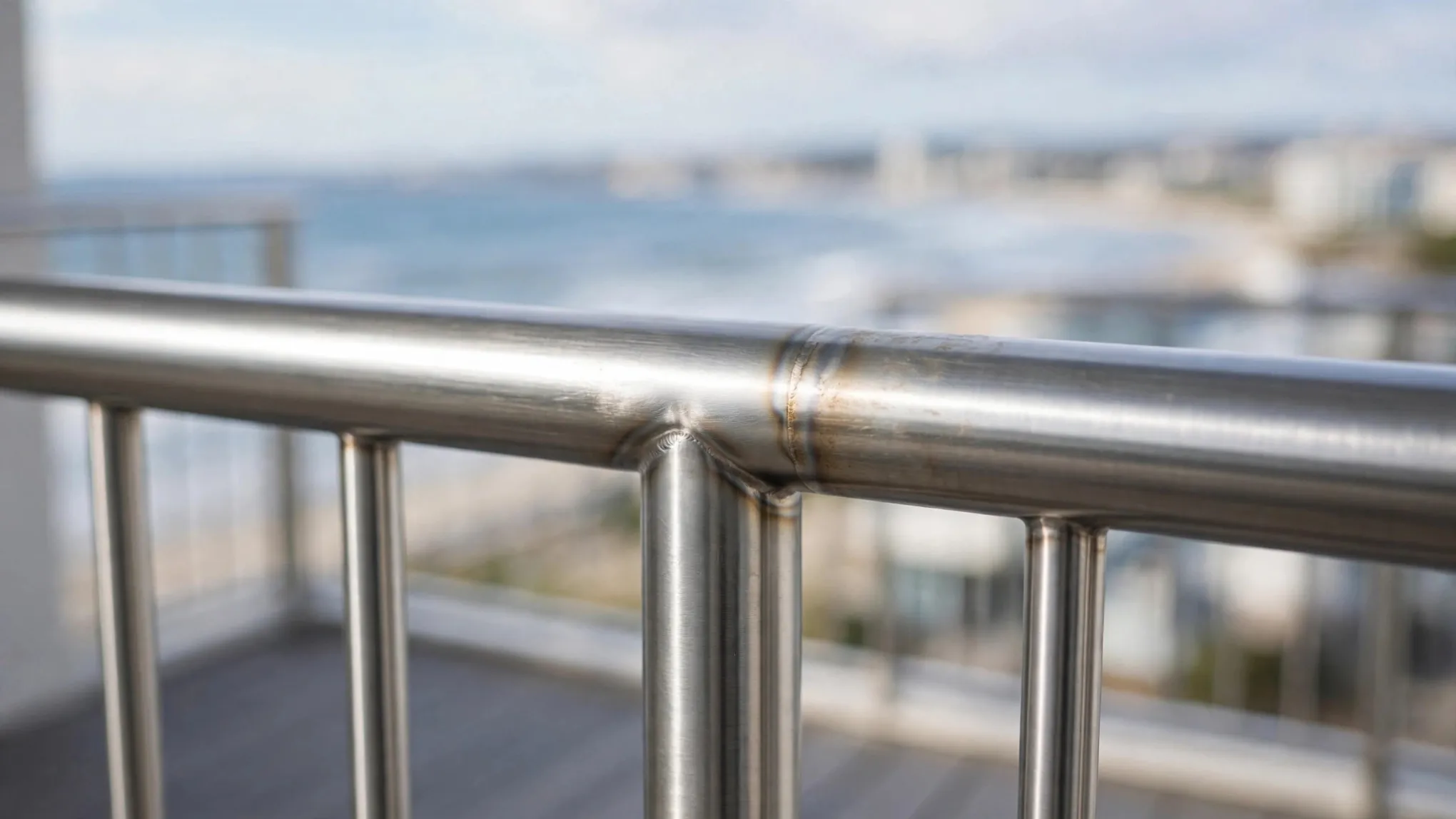
A railing is many pieces joined together, and every joint is a potential weak point. Welding heats the steel until the chromium in the heat-affected zone reacts with carbon and oxygen, forming a dark discolouration around the weld called heat tint — a changed surface layer whose passive film is thinner and less protective. Stains love to start there, so the first brown marks on a new railing often appear in a neat line beside a weld. A well-made railing should never be delivered with heat tint still visible: the fabricator should remove it by pickling, passivating, or polishing. Inspect the welds closely — a 304 stainless steel railing with properly finished welds will outperform a carelessly welded 316 railing.
Contamination from Carbon Steel Tools
One of the least-known causes of staining is also one of the most common: tiny particles of ordinary carbon steel embedded in the surface rust and leave brown marks that look like the railing is failing. This usually happens during fabrication or installation, when stainless steel meets carbon steel tools, grinding discs, or workbenches that have handled mild steel. A steel brush used on a mild-steel gate and then on a stainless railing transfers iron into the surface, and once embedded, the particles rust in the first rain. The giveaway is the pattern: scattered spots where the metal was handled, rather than the broad wash of tea-staining. Prevention is workshop discipline — stainless-only tools and clean workbenches — so ask any factory how they keep carbon steel away from stainless steel.
How to Clean Stains Safely
Most stains can be removed without special equipment. Start with the gentlest approach: warm water with a mild detergent and a soft cloth will remove dust, salt, and light tea-staining in most cases; rinse with clean water and dry the surface. For more stubborn staining, a dedicated stainless-steel cleaner or a paste of baking soda and water, applied with a soft cloth, will usually lift the discolouration without scratching. What you should never use matters just as much: chlorine bleach, hydrochloric acid cleaners, and abrasive powders attack the passive layer, while steel wool and carbon-steel wire brushes clean one stain and embed the iron that causes the next one. If a stain resists gentle cleaning, a citric-acid passivation cleaner used exactly as directed can restore the surface.
Preventing Stains Before They Start
Cleaning removes stains; prevention stops them forming, and prevention is mostly decided before the railing is ordered: choose the grade for the location — 316 near the sea or a pool, 304 inland — ask how the welds are finished and whether the factory pickles or passivates after welding, and keep the railing protected during installation. Once it is in place, rinse it with fresh water a few times a year inland, and monthly on a seafront balcony, paying attention to the sheltered spots where moisture and salt linger.
Design can help as well. A Luxury Gothic Metal Balcony Railing is a wrought iron outdoor railing for a traditional villa or hotel balcony. A Mediterranean Villa Powder-Coated Aluminum European Scroll Balcony Railing suits a coastal setting, its powder-coated finish shedding salt. A Modern Luxury Metal Balcony Railing with Tree Pattern pairs a decorative steel pattern with an easy-clean finish; iron outdoor railings remain a strong choice for a heavier, traditional look. A Modern Mansion Antique Copper Vertical Bar Balcony Railing offers a different answer, copper developing its own patina, while a Modern Mansion Stainless Steel Brass Woven Pattern Balcony Railing combines stainless steel with brass for a warmer look. A Modern Neoclassical Metal Balcony Railing Greek Key Pattern rounds out the range for classical facades. When you compare balcony railings designs, ask how the joints are made, and compare balcony railings designs against the climate they must survive.
The right material matches both the building and the climate it stands in. With the right grade, properly finished welds, and a little routine care, a well-chosen 304 stainless steel railing will stay bright for years with nothing more than the occasional rinse.
Kaiyubang's workshop in Foshan builds balcony railings, gates, screens, and relief panels to order for hotels, villas, and design firms, working from your drawings and site photographs in 304 or 316 stainless steel, wrought iron, aluminium, brass, and copper. Every 304 stainless steel railing we build is made to your measurements and finish, with welds cleaned and passivated before dispatch. Expect a quotation within one business day and delivery in 2–4 weeks once the design is confirmed. Send drawings and photos to vivianvee639@gmail.com, call +86 13715181867, or reach us on WhatsApp to start your quote.