Oct 21, 2026 Choose Guiding
Hard-to-Grip Handrails? Choose a Better Profile
A stair railing can look elegant yet feel awkward to hold. Compare handrail profiles, clearance, joints, and outdoor details before ordering.
Hard-to-Grip Handrails? Choose a Better Profile
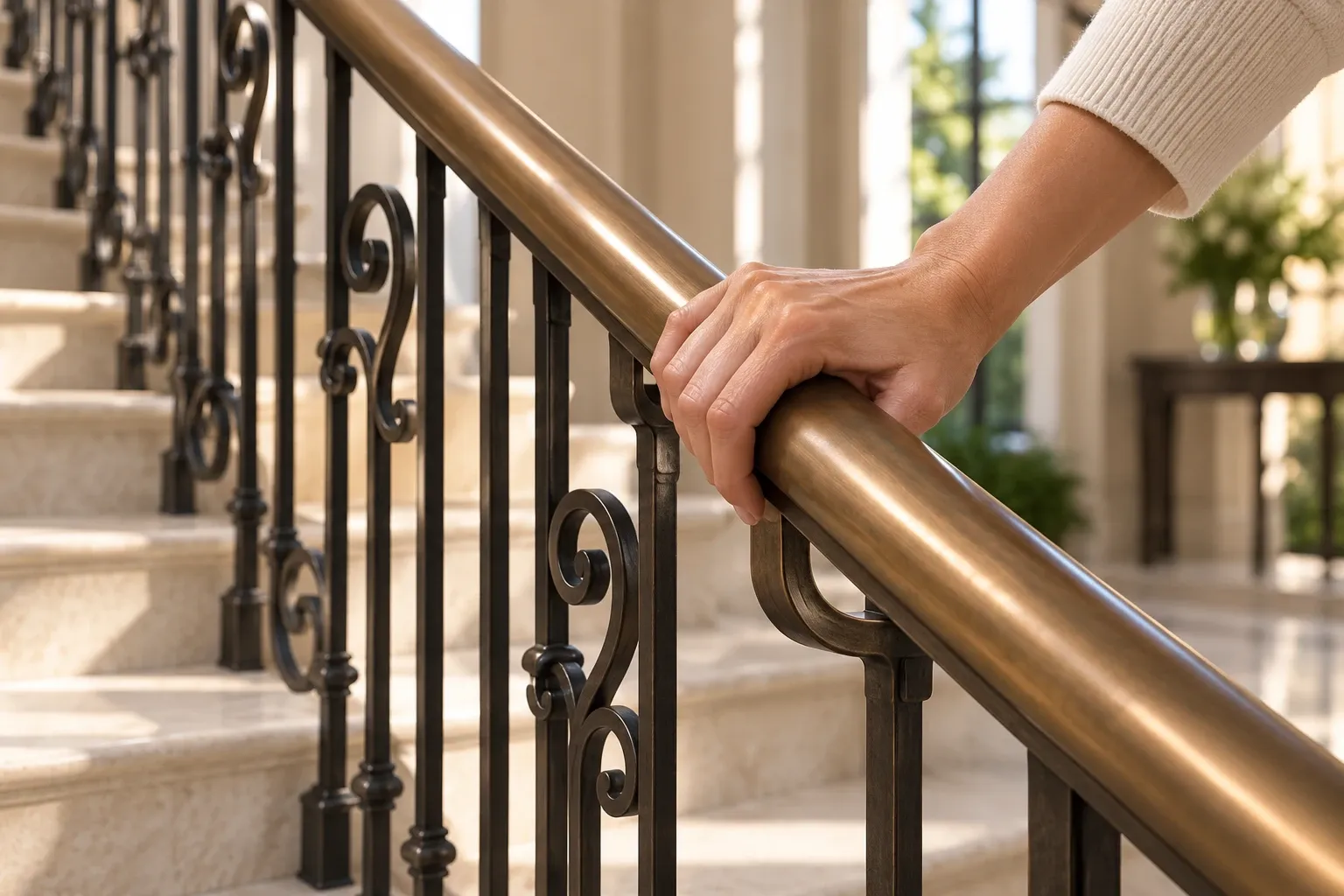
A stair railing can look elegant and still feel awkward to hold. A broad top, sharp transition, bulky ornament, or poorly placed bracket can interrupt the grip people expect when using stairs.
Choosing a better handrail starts with its profile, but also means reviewing clearance, continuity, surface finish, and installation. The most useful question is not simply whether it looks attractive, but whether the complete arrangement supports comfortable use.
Separate the Handrail from the Guard
A guard helps protect an open edge. A handrail provides a surface to grasp. One component may perform both roles when properly designed, but a decorative guard top is not automatically a suitable gripping rail.
This distinction matters for a deck railing or porch railing with a broad cap. Where a graspable rail is required, a separate stair handrail may be needed beside the stair flight.
When reviewing decorative railings, identify the guard, gripping rail, posts, and infill on the drawings.
Why Some Handrails Are Difficult to Grip
Common problems include an oversized profile, abrupt edges, insufficient finger clearance, rough joints, or ornaments that interrupt the hand's movement.
A search such as “handrail stair rails” can return complete assemblies and individual components together. Confirm which part provides the actual gripping surface before comparing products.
Balusters and decorative infill shape the appearance of stair railings, but they should be coordinated with the handrail rather than obstructing it.
Compare Profiles Using Actual Samples
Round Profiles
A round profile offers a consistent surface around its circumference. Its suitability still depends on dimensions, clearance, installation, and applicable requirements. Round does not automatically mean compliant.
Non-Circular Profiles
Oval and other shaped profiles may be appropriate when their geometry supports grasping and satisfies the relevant requirements. A wide flat top may suit a guard visually without serving as the required handrail.
The U.S. Access Board's stair handrail guidance addresses gripping surfaces, continuity, clearance, and related details. It is a useful reference for projects within its scope; confirm the rules governing the actual building and location.
Decorative Profiles
A wrought iron railing can retain scrolls and ornamental details while using a simpler gripping rail. Place decorative emphasis where it does not interfere with the hand's path.
Request a short sample with the proposed finish and bracket. Handle it at approximately the installed orientation instead of judging only a photograph.
Review Clearance and Continuity
Even a comfortable profile can perform poorly when it sits too close to a wall or meets an awkward corner.
Review the stair rail along its entire route: straight runs, bends, joints, brackets, and ends. Check whether the hand can move without encountering rough edges or unnecessary obstructions. Confirm required transitions and terminations with the project designer.
Before approving a railing for stairs, ask for drawings showing:
- The gripping profile and dimensions.
- Clearance around the rail.
- Bracket positions and connections.
- Transitions at corners and landings.
- End details and installation references.
Match the Infill Without Losing the Grip
Cable Railing
Cable railing can preserve views, but the cables do not replace a handrail. Coordinate the gripping rail with the complete guard design, including posts, connections, and project requirements.
Glass Railing
A glass railing may use a top cap, a separate rail, or another system-specific arrangement. Do not assume that an exposed edge or cap provides the required grip. Confirm the complete assembly.
Traditional Metal Railings
Vertical pickets and decorative balusters can complement a round or shaped rail. Review both the visual composition and the point where users place their hands.
Outdoor Handrails Need More Than a Good Profile
An outdoor stair railing must suit its exposure as well as its users. Rain, coastal conditions, direct sun, cleaning products, and connections between materials can affect long-term performance.
An aluminum deck railing may offer a coordinated exterior system, but its broad top should still be assessed separately from the stair gripping rail. Apply the same distinction when comparing deck railings and porch railings.
Specify materials, finishes, compatible fixings, and care instructions. Consider surface temperature in direct sun and how the rail will be cleaned. A deck and railing package should clearly identify which components serve the steps and which protect the perimeter.
Compare Suppliers Using the Same Questions
Whether researching Viewrail or another supplier, compare actual profiles and complete systems rather than appearance alone. The Viewrail handrail range is one example of a supplier presenting distinct handrail options; it is not evidence that any option suits every project.
Ask each supplier for the same information: profile drawings, material and finish details, support arrangements, installation scope, and project-relevant documentation.
Five Checks Before Ordering
- Identify where a graspable handrail is required.
- Review a physical profile sample and its finish.
- Confirm clearance, joints, brackets, and continuity.
- Verify site dimensions and supporting conditions.
- Agree on drawings, inspection, delivery, and care.
Avoid changing the stair finish or support positions without notifying the fabricator. These changes can affect the final installation.
Choose a Profile for the Way the Rail Will Be Used
Comfortable handrails depend on the complete design: shape, clearance, continuity, finish, and secure support.
A refined stair railing can combine decorative character with a practical gripping surface. Start with the user's contact point, then coordinate the surrounding details.
To discuss custom metalwork, contact Kaiyubang about your stair railing with drawings, site dimensions, preferred profiles, exposure conditions, and installation requirements.