Oct 20, 2026 Choose Guiding
Metal Relief Panels Look Flat? Review the Depth
Metal wall panels look flat? Learn how relief depth, lighting, finish, and sample approval help decorative metal panels achieve the intended effect.

Metal Relief Panels Look Flat? Review the Depth
Metal wall panels can look dramatic in a rendering yet surprisingly flat after installation. Before assuming the panel needs deeper embossing, review the relationship between its physical relief, pattern scale, surface finish, and lighting.
A successful metal relief wall depends on more than one measurement. Raised details need the right visual conditions to remain legible from the intended viewing position.
Here is how to identify the problem and confirm the design before production.
Why Decorative Metal Panels Can Look Flat
A metal panel has physical geometry, but viewers experience that geometry through highlights, shadows, and changing reflections.
A shallow pattern may look expressive under directional light. A deeper design may appear less dimensional under broad frontal illumination. Fine details can also disappear when viewed across a large lobby.
Common reasons include:
- Relief that is too subtle for the viewing distance.
- A pattern enlarged without reviewing its proportions.
- Lighting that produces little distinction between raised and recessed areas.
- Strong reflections that obscure the design.
- A finish that makes adjacent surfaces look too similar.
- Expectations based on a heavily stylized rendering.
Start by comparing the approved design, sample, and installed conditions. Changing the depth alone may not address the actual cause.
Understand What “Depth” Means in a Metal Wall Panel
Material Thickness Is Not Relief Depth
These dimensions describe different things.
Material thickness refers to the metal itself. Relief depth describes the difference between the raised and recessed parts of the design. Overall assembly depth includes the panel, backing, frame, and mounting arrangement.
A thin sheet can be formed into a raised pattern. A thicker plate can still have a visually shallow surface.
Ask the supplier to identify these dimensions separately on a section drawing. Avoid approving a product based only on a description such as “thick metal panel.”
Deeper Is Not Automatically Better
Greater projection can create more pronounced shadows, but it can also affect fabrication, cleaning, packaging, and installation clearances.
There is no universal relief depth that suits every design. The appropriate geometry depends on the material, production method, motif, panel size, and viewing conditions.
For large decorative metal panels, request a representative sample that includes both prominent features and quieter background areas.
Distinguish Metal Embossing from Other Surface Treatments
Metal embossing forms raised or recessed patterns in metal. Other methods can create different decorative effects, so confirm how the proposed product will be made.
Product or treatment | Main visual effect | What to confirm |
|---|---|---|
Embossed metal | Formed raised and recessed patterns | Profile, material, forming method, and repeat size |
Hammered copper | Small-scale surface variation and reflections | Texture consistency and actual material |
Cast metal relief | Sculptural detail formed through casting | Weight, detail quality, and fixing arrangement |
Fabricated relief | Built-up shapes and assembled elements | Joints, weld treatment, and overall projection |
Perforated metal panels | Openings that reveal light or a background | Opening pattern, backing, and edge treatment |
Hammered copper can introduce lively texture without producing the same layered imagery as a botanical or landscape relief.
Similarly, perforated metal panels create openness rather than necessarily creating raised forms. Combining perforation and relief is possible, but each feature should be specified clearly.
Review Lighting Before Changing the Panel
Compare Frontal and Directional Light
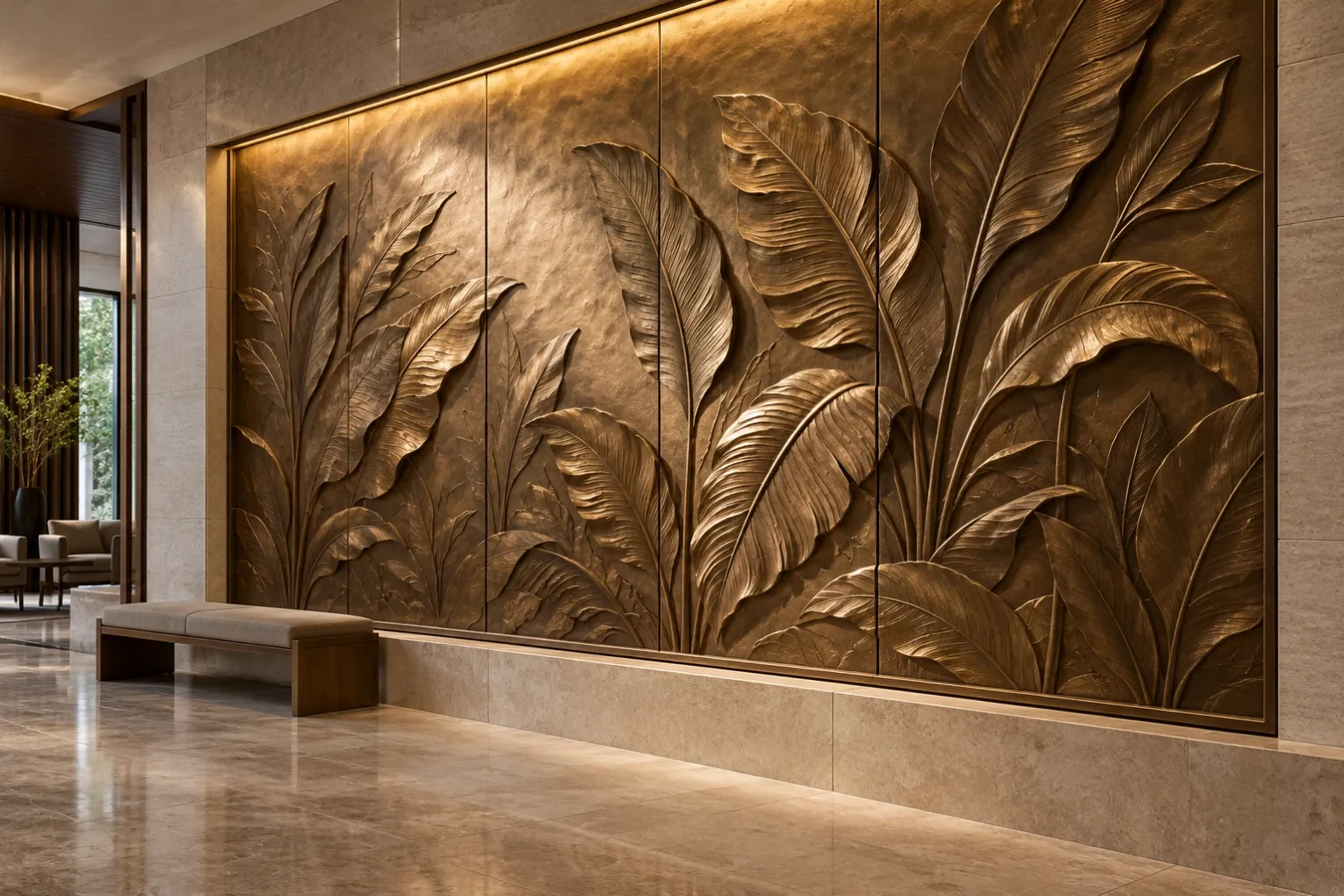
Broad frontal light can reduce visible shadows. Light arriving at an angle can reveal changes in the surface profile.
However, strong grazing light may also emphasize panel distortion, joints, or surface irregularities. The goal is controlled definition, not the strongest possible shadow.
Review the sample under:
- Daylight similar to the installation area.
- The proposed artificial lighting.
- An alternative light direction for comparison.
Keep the sample and camera position consistent when comparing results.
Check More Than One Viewing Position
Metal panels for walls may be seen from an entrance, a reception desk, or a nearby seating area. A design that works from one position may produce glare from another.
Walk through the intended approach and review the panel at realistic distances. For a large feature wall, check the complete composition as well as close-up craftsmanship.
Choose a Finish That Supports the Relief
Polished areas can emphasize highlights, while brushed, textured, or darker areas can change how the design reads. None is automatically the correct choice.
Approve physical samples rather than relying on finish names. “Bronze,” “antique copper,” and “champagne gold” describe appearances without necessarily identifying the underlying material.
Unprotected copper and its alloys can also change appearance through exposure. The Copper Development Association explains this behavior in its guidance on copper and bronze weathering.
Ask whether the supplied finish is intended to age naturally or retain a particular appearance, and request the corresponding care instructions.
Specify Decorative Sheet Metal Clearly
Decorative sheet metal is a broad category. It can include embossed, perforated, textured, coated, and otherwise finished products.
When comparing decorative metal sheets, identify:
- Base material and grade.
- Material thickness.
- Pattern dimensions and orientation.
- Relief profile and overall projection.
- Finish reference and acceptable variation.
- Panel dimensions and edge treatment.
- Backing, frame, and fixing requirements.
For steel wall panels, clarify whether the specification calls for carbon steel or stainless steel. The material and protective treatment should suit the intended exposure.
Do not infer corrosion resistance, fire performance, or structural suitability from the metallic appearance alone. Review the complete proposed assembly against the project requirements.
Do Ceiling Panels Need the Same Review?
The same principles apply to a decorative ceiling, but the viewing direction and installation conditions differ.
Copper ceiling tiles may feature shallow repeated patterns that read differently overhead than they do on a sample table. Review the pattern at an approximate installed height, with the proposed lighting direction.
Also coordinate:
- Panel weight and support.
- Access to services above the ceiling.
- Lighting, ventilation, and other openings.
- Edge details and repeat alignment.
- Applicable project documentation.
A decorative wall sample should not automatically be treated as an approved ceiling system.
Approve a Sample That Answers the Right Questions
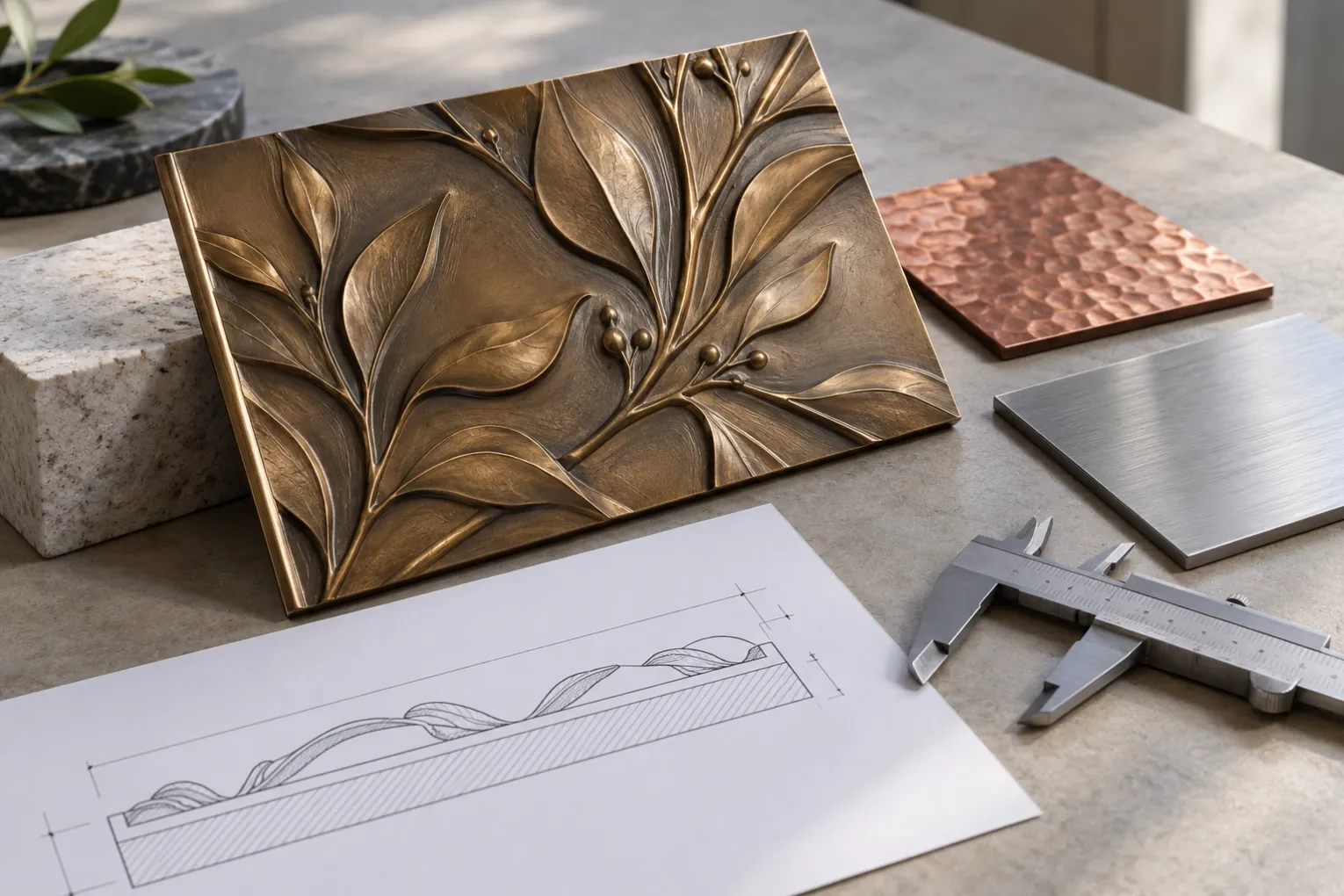
A small flat finish swatch confirms color and texture more effectively than it confirms a large relief composition.
For custom work, consider a sample package that includes:
Review item | What it helps confirm |
|---|---|
Finish swatch | Color, sheen, and surface texture |
Representative relief sample | Raised details and transitions |
Section drawing | Thickness, projection, and assembly depth |
Full elevation | Pattern scale and panel layout |
Joint detail or mockup | Alignment and visible seams |
Lighting review | Appearance under intended conditions |
Record which sample and drawing revision govern production. Photographs help document the decision, but they do not replace the physical reference.
Coordinate Depth with Installation and Maintenance
Relief geometry affects more than appearance.
Check whether projecting details interfere with furniture, circulation, adjacent finishes, or cleaning access. Confirm how the panels will be handled and supported without loading delicate raised areas.
For multi-panel artwork, review how the motif continues across joints. Uneven installation or an interrupted pattern can weaken the overall effect even when each individual panel is well made.
Provide the installer with agreed panel positions, fixing details, and handling instructions before delivery.
Make Metal Relief Panels Read as Intended
When metal relief panels look flat, review the complete visual and technical arrangement: geometry, scale, finish, light, and installation.
The best next step is usually a representative sample and a coordinated drawing—not an unqualified request for deeper embossing.
Planning custom metal wall panels? Discuss your decorative panel project with Kaiyubang, sharing the artwork, wall dimensions, viewing distance, lighting concept, and preferred finish. Use those details to agree on samples and specifications before production.