
Oct 19, 2026 Choose Guiding
Room Divider Ideas for Privacy and Style
Explore room divider ideas for privacy, zoning, and style. Compare curtains, folding screens, shelving, and decorative metal panels for your space.
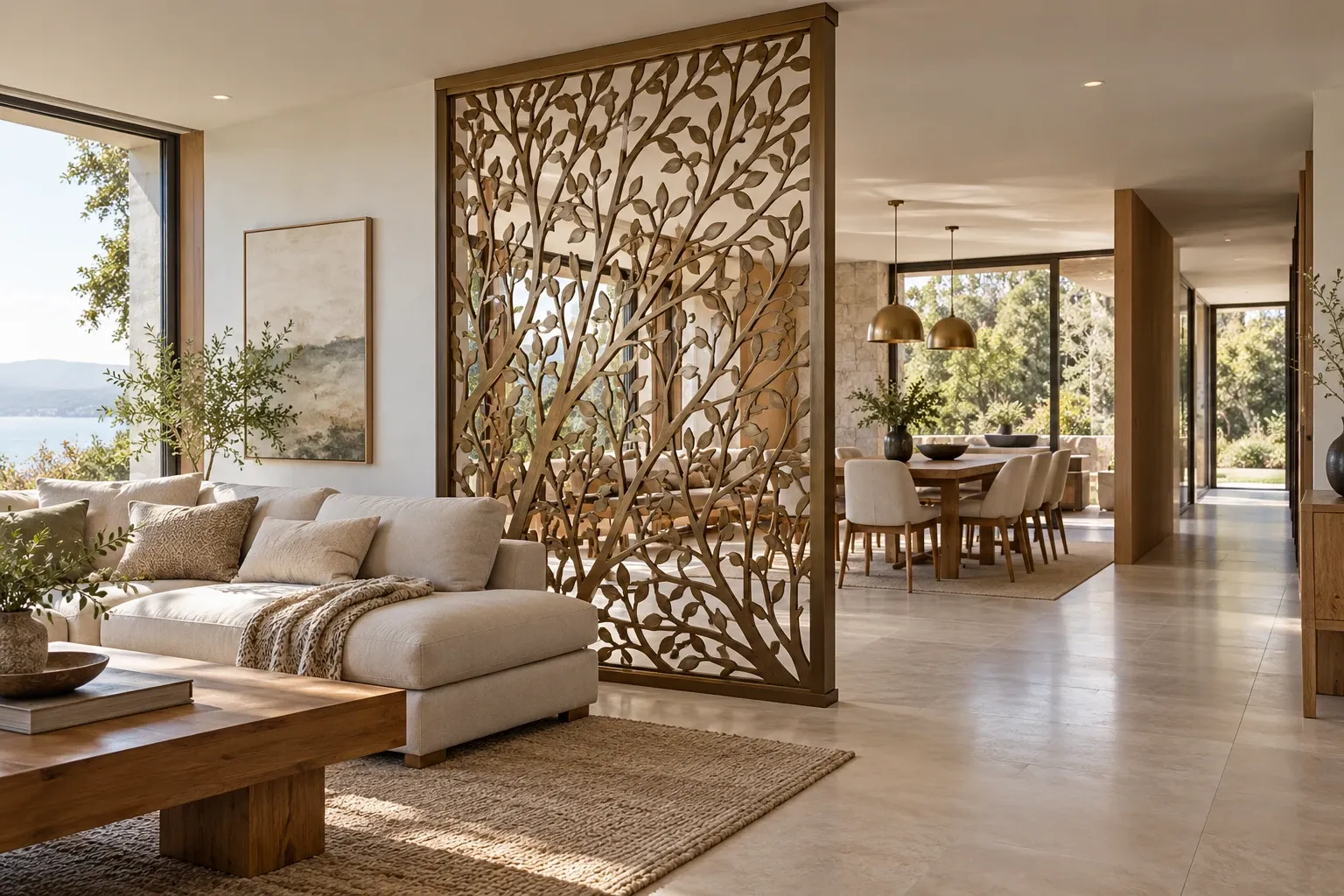
Room Divider Ideas for Privacy and Style
A room divider can make an open space more useful without building a permanent wall. It can define a home office, screen a sleeping area, or create a welcoming transition between an entrance and a living room.
The best choice depends on the problem you want to solve. Room divider curtains offer adjustable visual privacy, a folding room divider provides portable screening, and decorative metal panels can become part of the room’s architectural design.
Start with your daily routine, then choose a divider that supports it.
Turn an Open Room into Useful Zones
Open-plan rooms feel more organized when each activity has a recognizable place. A divider can establish that boundary without separating the areas completely.
Create an Entrance Buffer
If your front door opens directly into the living room, place a screen beside the entrance to soften the immediate view of the seating area.
Leave a clear route into the room and enough space for the door to open fully. An open-pattern panel can suggest an entryway while allowing views and daylight through.
Separate Living and Dining Areas
Position a divider near the transition between the sofa and dining table rather than through the middle of either activity zone.
A partial-width screen often provides enough definition. Coordinate it with a rug or pendant light to reinforce the layout without adding unnecessary barriers.
Define a Home Office Corner
A screen beside a desk can reduce visual distractions and separate work equipment from the rest of the room. Check the view from your chair and the background visible during video calls before deciding on placement.
Visual screening does not guarantee acoustic privacy. If confidential conversations or noise control are priorities, discuss a suitable acoustic solution separately.
Use Room Divider Curtains for Adjustable Privacy
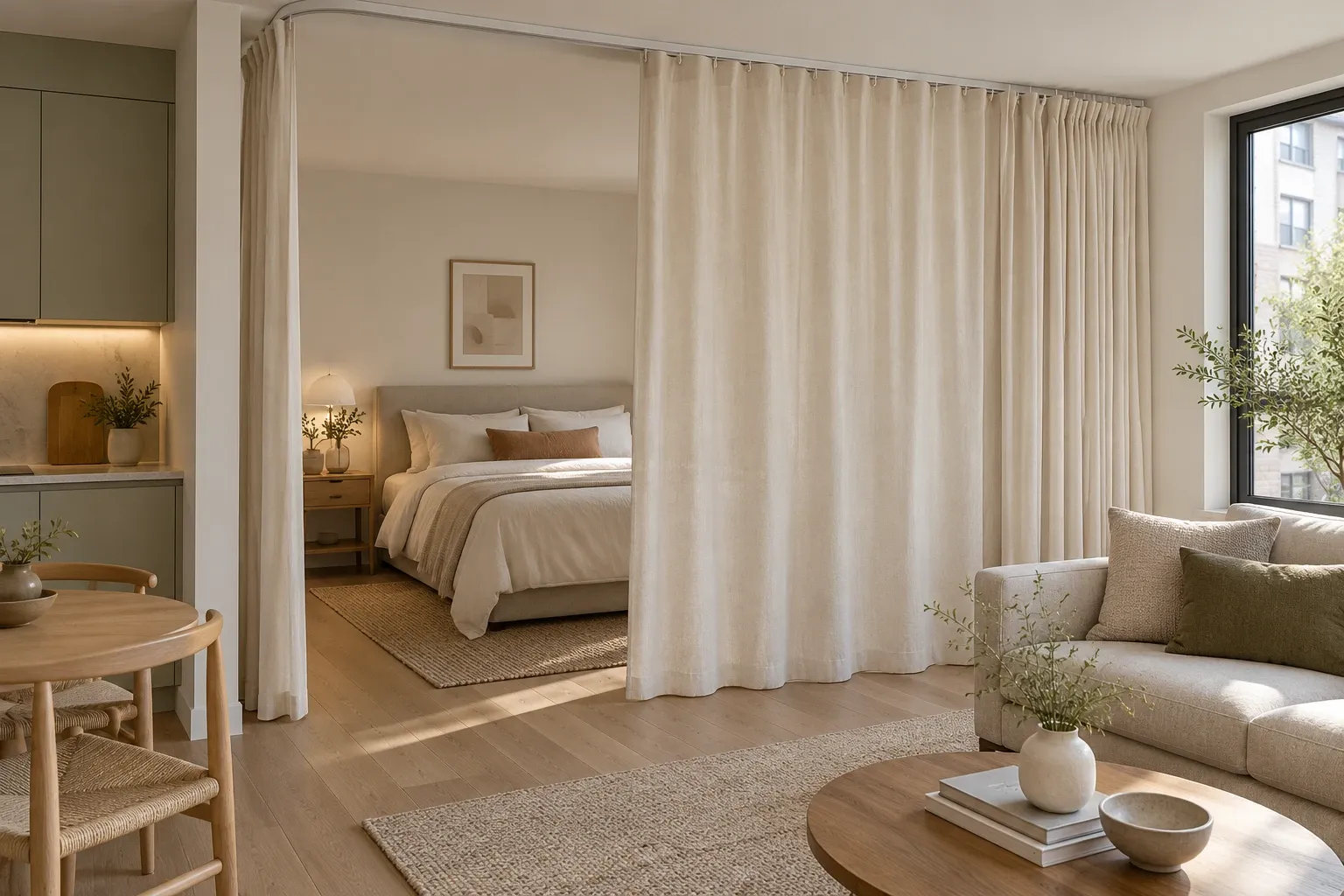
Room divider curtains suit spaces that need to change throughout the day. Open them to connect the room, then close them when visual privacy is needed.
They can work particularly well:
- Around a sleeping area in a studio apartment.
- Between a dressing space and bedroom.
- Across an occasional guest area.
- In front of open storage or hobby supplies.
Choose Fabric for the Actual Privacy Requirement
Opaque fabrics provide stronger visual screening than sheer materials. Sheer curtains can soften a boundary, but they offer limited privacy, particularly when the space behind them is brightly lit.
Consider how the fabric looks from both sides. This matters when both areas are occupied regularly.
Plan the Track and Curtain Stack
Measure the opening and the space needed for the curtains to gather when open. A panel that looks compact when closed may cover a window or doorway when stacked.
Ceiling tracks and rods need suitable support. For rental properties, confirm which fixings and alterations are permitted before installation.
Make a Folding Room Divider Part of the Decor
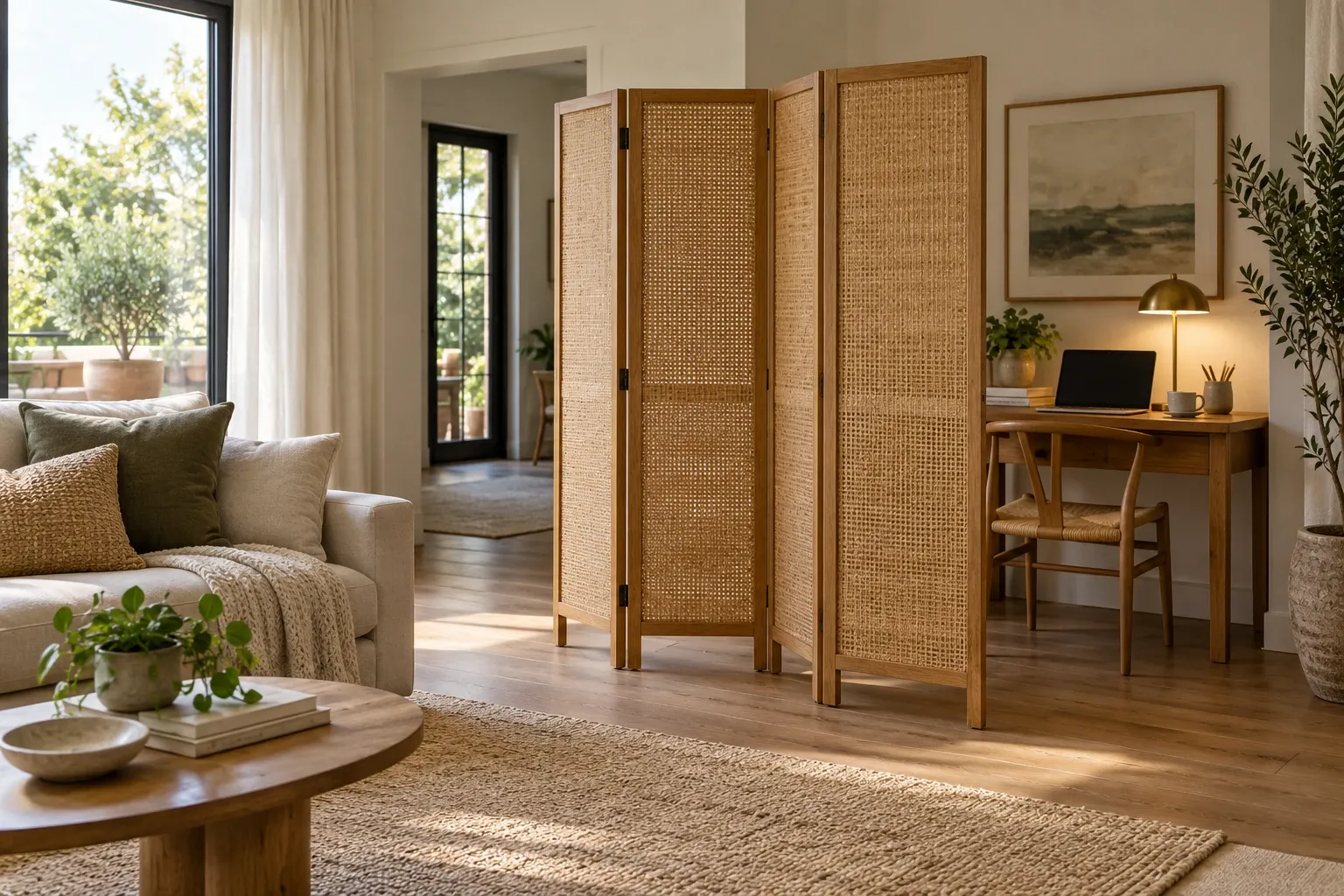
A folding room divider offers flexibility when permanent installation is unnecessary or impractical.
Use one to screen a changing area, conceal a workspace, or separate an occasional guest setup. Choose its height according to the sightlines you want to interrupt.
Wood and woven panels can add warmth. Fabric-covered screens create a softer appearance, while metal frames can complement contemporary furniture.
Check Weight and Stability
Not every folding screen is lightweight. Confirm its weight, folded dimensions, hinge arrangement, and recommended standing position.
Follow the manufacturer’s instructions for the opening angle and support. Keep it away from busy circulation routes where it could be knocked over.
A screen should be convenient to use, rather than something you must repeatedly move out of the way.
Add Architectural Character with Decorative Metal Room Dividers
Decorative metal room dividers can define space while introducing pattern, texture, and a coordinated finish.
A fixed panel beside a sofa can mark the boundary of a dining area. In an entrance hall, a screen can create a transition into the main room. A panel beside a reading chair can provide visual shelter while preserving views through the interior.
Match the Pattern to the Setting
Larger openings maintain more sightlines. Denser patterns provide greater screening, although open metalwork does not offer the same privacy as a solid partition.
A tree-branch metal screen design is one option for interiors that draw on botanical forms. Geometric patterns may suit spaces with repeated lines and a more structured layout.
Consider the view from both sides, including how the panel looks against furniture, windows, and artificial lighting.
Coordinate the Finish and Installation
Repeat a finish already present in lighting, handles, or furniture details to help the divider feel connected to the room.
Before ordering, confirm:
- Overall height and width.
- Material and surface finish.
- Panel joints and frame details.
- Fixing positions and supporting surfaces.
- Installation access and cleaning requirements.
Fixed screens and freestanding dividers require different support arrangements. Agree on the installation method before fabrication.
Use Shelving to Combine Separation and Storage
An open shelving unit can define a dining area, organize a work corner, or create a boundary behind a sofa.
Style it from both sides when both faces are visible. A combination of books, baskets, and open space usually creates a lighter appearance than filling every shelf.
Check that the unit is intended for the proposed position and use. A bookcase designed to stand against a wall may not be suitable as an unsupported room divider.
The U.S. Consumer Product Safety Commission’s furniture anchoring guidance for shelving dividers explains the importance of securing furniture according to the manufacturer’s instructions. If the unit cannot be anchored as required in your preferred position, choose another solution.
Which Room Divider Style Fits Your Space?
Compare the practical limits as well as the appearance.
Divider type | Best use | Visual privacy | Main consideration |
|---|---|---|---|
Opaque curtains | Sleeping and guest areas | Stronger screening when closed | Track support and curtain stacking space |
Sheer curtains | Gentle zoning | Limited | Visibility changes with lighting |
Folding screen | Temporary work or dressing areas | Depends on panel construction | Stability, weight, and storage |
Open shelving | Zoning with storage | Partial | Intended use, loading, and anchoring |
Decorative metal screen | Architectural zoning and pattern | Depends on opening density | Support details and installation |
Plant grouping | Soft separation in bright interiors | Limited | Light, watering, and floor protection |
No divider solves every problem equally well. Decide whether privacy, portability, storage, or decorative impact matters most before comparing designs.
Hide Clutter Without Creating a Storage Problem
A divider can screen laundry baskets, craft supplies, or a desk between uses. It works best when the concealed area remains organized.
Give the hidden zone a clear purpose. Add suitable storage and leave enough access to retrieve items comfortably.
Avoid screening equipment that needs ventilation or regular inspection. Keep exits, controls, and essential access points unobstructed.
Style Both Sides of the Divider
A divider becomes part of two spaces at once.
Repeat materials or colors from the surrounding room, and consider lighting on both sides. A floor lamp or table light can prevent the screened area from feeling neglected.
Use height deliberately. Lower screens maintain a more connected room, while taller panels provide stronger visual separation and have a greater impact on daylight and views.
Before buying, mark the proposed footprint on the floor. Walk through the space and check the layout with doors open, chairs pulled out, and curtains gathered.
Plan Your Room Divider Before Ordering
A short planning check can prevent an attractive idea from becoming an everyday obstruction:
- Identify the activity or view you want to separate.
- Measure the space using finished floor and wall surfaces.
- Check circulation, door movement, daylight, and ventilation.
- Decide whether the divider must move or remain fixed.
- Confirm stability, supports, and installation responsibilities.
- Review samples and drawings for a custom design.
If several people share the room, include their routines in the decision.
Make Your Space Work Better
A room divider can introduce privacy, clearer zones, and decorative character without necessarily creating another enclosed room.
Choose room divider curtains for adjustable screening, a folding room divider for flexible placement, or a decorative metal panel for a more architectural feature.
Planning a custom metal screen? Discuss your room divider design with Kaiyubang, sharing room photographs, dimensions, preferred patterns, and installation conditions. Confirm the material, finish, and support details before production.